
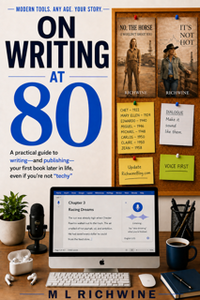
 On Writing at 80
Given on 6/3/26
I want to start by reading a story.
It’s the scene that started all of this — the first thing I wrote that made me think: maybe there’s a book here.
These stories trace back to Speedway, Indiana, in 1960. Over the next thirty years, they came little by little — at kitchen tables, garages, racetracks, over coffee, and sometimes late at night when people finally started talking about the things they usually kept to themselves.
This story was told to me by Mary Ellen herself.
The morning sun over the Madisonville, Texas ranch looked like it always did — hard and white and already mean by nine-thirty. The fences shimmered silver, cicadas shrilled in the pines, and the smell of hay mixed with motor oil drifted out of the shed where Chet Rawlins kept his tack, race cars, sports cars, trucks, and other detritus picked up in his various adventures.
He was out there that day on one leg. The other was in a plaster cast up to the knee, scrawled with phone numbers and crude jokes from the Houston crew. Two weeks earlier, that same leg had been bent sideways after a horse named Rattler pitched him into the dirt like a sack of feed. Any reasonable man would’ve stayed inside, but Chet Rawlins wasn’t raised on reason.
He was halfway through cinching the saddle when the kitchen screen door banged. Mary Ellen stepped onto the porch, apron still on. Her hair, not a single curl out of place. She wasn’t angry yet, just studying him the way she did when she thought he was doing something he ought not be doing.
“You can’t even walk, Chet,” she said. “What’s your plan if he throws you again?”
“I won’t give him the chance,” he said. “He’ll mind this time.”
“Uh-huh.”
Mary Ellen leaned against the porch rail. Her eyes gleamed in the sun.
Chet limped around the horse’s flank, cussing softly, trying to act like the leg didn’t hurt. The horse flicked an ear, unimpressed.
“You and me are gonna get along today,” Chet said. “Ain’t that right, boy?”
Rattler stamped once. Dust puffed around Chet’s boot.
Mary Ellen called out again. “You remember what Doc told you about that leg?”
“I remember,” he said, adjusting the stirrup. “He said don’t do anything stupid.”
“And here you are, doing exactly that.”
Chet grinned. “Darlin’, I’ve been thrown by worse horses than this nag.”
“That’s what worries me.”
He swung the saddle up, nearly lost his balance, caught himself on the fence. The cast made a dull thump. Pain flared bright behind his knee. He swallowed hard and kept working. The horse turned its head, eye rolling white.
Mary Ellen disappeared back inside, and for a moment Chet figured he’d won. Then the screen door creaked again. She walked back out with the Winchester lever-action .30-30 rifle leveled across her arms, the same one Chet had bought her years ago, beautifully engraved with gold flowers on the body. She carried it light, casual, but there was a look in her eye that meant she’d made up her mind about something. He heard the distinctive click-clack of the lever being cocked.
Chet froze halfway through tightening the girth strap.
“Now hold on,” he said. “You fixin’ to shoot me, Mary Ellen?”
She didn’t smile.
“No. The horse.”
For a heartbeat, even the wind quit moving.
Then Rattler snorted, stamped once more, and backed off like he’d understood every word. Chet stared at the rifle, at Mary Ellen, at the horse, and finally sat himself down on the fence rail, breathing hard.
Mary Ellen walked closer, resting the Winchester against her shoulder.
“You’re gonna bust that leg clean off if you keep at it.”
“Maybe,” he said. “But he’s gotta learn who’s boss.”
She tilted her head. “Looks to me like he already has.”
“Now come eat before I feed your breakfast and your favorite pie to the dogs.”
He laughed, half sheepish, half proud of her nerve. “You scare me sometimes, Miz Rawlins.”
“Good,” she said. “Keeps you alive.”
I wrote that in September of 2025.
I had just joined a writers workshop when I shared this piece. And I remember walking out of there thinking: I know about thirteen more stories like this. Stories I’d been carrying around for years.
These small stories — 1,500 words or so — became the backbone of the novels.
I was seventy-nine years old. Never written a book. Typed like a tired woodpecker. No publisher. No agent. No English degree. No idea what I was doing.
No, The Horse came out in March of 2026. Book Two — It’s Not Hot — comes out in June. And I’m now finishing a third book called On Writing at 80 — which is about exactly what I’m going to tell you tonight.
Because the question I keep getting asked is always the same:
How did you do that?
That’s what tonight is about.
And I want to be honest with you upfront:
I’m not here to sell you books.
I suspect many people in this room have something worth putting down on paper — a story, a memoir, a family history, a handful of scenes for the grandchildren.
What surprised me was how many of the old obstacles had become manageable.
The barriers against writing are mostly gone.
You just don’t know they’re gone yet.
Initially I saw four barriers:
The First Barrier: I Can’t Type
I cannot type well.
At eighty years old I was not about to hammer out eighty thousand words on a keyboard. That would have taken a geological era.
What I discovered instead was dictation built right into Microsoft Word on my Mac.
You press a button. You talk. The words appear on the screen.
Now — I grew up around storytellers. Texas truckers. Ranchers. Race drivers. Men and women sitting around kitchen tables with stories that rolled along with rhythm and timing and pauses.
Nobody handed out manuscripts afterward.
The stories lived in the telling.
When I started dictating, I realized something immediately:
I can tell a story far faster than I can type one.
The problem was never imagination.
The problem was translation.
Dictation removed that barrier.
Suddenly the scenes arrived almost at the speed I was imagining them. It felt less like typing a book and more like telling one.
Later, I started calling this voice-first writing.
For most of my life, I thought writing began with a keyboard. What I discovered was that stories begin with a voice. Long before there were typewriters, word processors, or publishing companies, there were people sitting around fires, kitchen tables, church socials, front porches, and pickup trucks telling stories.
The voice comes first. The technology comes later.
Everything else we’re talking about tonight — dictation, AI, publishing, even cowboy poetry — starts with that idea.
Dictation simply allowed me to work the same way many of us have always communicated our best stories — by telling them out loud.
Which — when you think about it — is exactly what a novel is.
Since September, I have written roughly 180,000 words. Oh, and an audio book on Spotify.
That sounds fast when you say it out loud. And in some ways, it is. But it is also three or four straight hours most mornings in my basement office — coffee, AirPods, Microsoft Word, and a story that keeps pulling me back downstairs.
That kind of pace is not that unusual anymore.
NaNo/WriMo is an ad hoc event where hundreds of thousands of authors try to write 50,000 words for a novel in the month of November. Water For elephants came from this effort.
Is dictation perfect?
Absolutely not.
The computer mishears things constantly. Especially Texas names. But it learns.
One of my books briefly contained a scene involving taco brakes instead of truck brakes.
Another converted “Ruidoso” into something that looked like a prescription medication.
(pause)
You learn to laugh about it.
But here’s what matters:
Speaking is natural. Typing, for most of us over sixty, is not.
Human beings told stories out loud for thousands of years before anyone touched a keyboard.
Dictation simply returns writing to its oldest form.
And for anyone in this room whose hands get tired, whose back stiffens up, whose eyes aren’t what they were — dictation changes the physical equation entirely.
You can write sitting comfortably. You can write looking out a window. You can write while walking slowly through the house.
The keyboard stops being the gatekeeper between your imagination and the page.
The Second Barrier: I Needed an Editor
A rough draft needs editing. Real editing.
Five years ago — really, even two or three years ago — writing a first novel meant developmental editors, line editors, copy editors, proofreaders, agents, publishers, and typesetters. Thousands of dollars and endless hoops before a reader ever saw your work.
I had no idea whether anyone besides my immediate family would ever read this book.
So I turned to artificial intelligence, I used Co-pilot, Claude, and my constant companion ChatGPT
Now, I know what some of you are thinking.
He had a robot write his book.
No.
I wrote every word.
Every story is mine. The memories, the characters, the rhythm, the humor, the rough edges — all mine.
What AI became was an endlessly patient junior editor sitting beside me at the desk.
I would say things like:
Find where I’m repeating myself.
Does this scene drag?
Fix the punctuation, but don’t rewrite my sentences.
And this instruction appeared at the start of almost every session:
Preserve my voice. Don’t make it polite. Don’t make it corporate.
Because that’s the real danger with these tools. They want to sand everything smooth. They’ll take your Texas trucker and make him sound like a press release.
You have to stay in charge.
I stayed in charge. The machine suggested. I decided.
That’s the whole arrangement.
And honestly, for anyone in this room who has ever felt embarrassed asking a question twice — or three times — or twenty times — AI is remarkable for that reason alone.
It never rolls its eyes. It never sighs. You can ask the same thing ten times and it answers like it’s the first time every single time.
At our age, that matters more than younger people understand.
The Third Barrier: Research
Here’s where it got genuinely fun.
Give me a research rabbit hole and I will disappear for hours. Time stands still. I forget lunch. My wife has learned to check on me periodically.
For these books I needed to know things like:
What hat did a Texas Ranger wear in 1955?
Who won Indianapolis in 1960?
What was it actually like flying over the Himalayas during World War II?
Memoirs by Burma Hump pilots were available free in droves on Kindle or Libby in seconds. Obscure Texas histories. Old racing archives. Regional newspapers from fifty years ago. All of it instantly accessible from a chair in my basement.
I also made a point of what I call intentional travel research.
Research gives you a reason to go somewhere. And at our age, having a reason to get out of Chicago in February is not a small thing.
In my case that mostly meant visiting Texas — which I would have done anyway, since three of my children and seven grandchildren live there. What changed is that I could now call it work.
(pause)
So I drove to Bastrop — a small river town about thirty miles east of Austin. Brick storefronts. The Colorado River sliding through town. Pickup trucks backed into angled parking spots looking like they are ready to race out. And a Buc-ee’s next door in case you need brisket jerky and gasoline at the same time.
(pause)
That’s Texas.
The Lone Star Cowboy Poetry Gathering 2026 ran three full days with more than 100 poets and musicians, and I loved that it still felt rough around the edges in the best possible way. Things were spread all over town — the Convention Center, the Historical Museum, the library, even the bowling alley.
The cowboy poets didn’t rush. In a world where everything seems double paced, this room operated at a horses gait.
It felt like one of those rare events that hadn’t quite been “discovered” yet. The curated Austin crowd hadn’t arrived with the ironic hats and designer cowboy boots. It still felt down home.
And that matters for a writer.
You hear how people talk. How they pause. What they joke about. What they avoid talking about.
A man in a canvas jacket was on stage who had been reciting the same poem about a stubborn fence post for thirty years and showed no signs of stopping.
At a common table a woman introduced herself and asked what I was doing here. I tried a new line and told her I was an author. She looked at me very seriously and said she hoped there wasn’t any sex in my novel — because she was a Christian.
(pause)
I told her it was about a Texas trucker.
She said that was probably fine.
(pause)
You can’t get that from the internet.
The Fourth Barrier: Publishing
Before I ever uploaded anything to Amazon and Kindle Direct Publishing, there was one piece of software that completely changed the process for me: Vellum.
Vellum lets you take what looks like an ordinary Word manuscript and instantly see it transformed into an actual book — with chapter headings, page breaks, a table of contents, and proper typography. For the first time, I wasn’t staring at a stack of pages. I was reading something that looked and felt like a real book on my Kindle.
For me, that was magic. Every time I finished a few chapters, I would run them through Vellum and read them as a reader instead of as a writer. It helped me see pacing problems, weak chapters, and places where the story dragged.
The software was created by two former Pixar engineers who thought authors ought to have access to the same kind of professional book design tools that once required a typesetter and a publishing house. This two-person company has reportedly sold over four million copies at $200 to independent writers. It became one of the secret weapons that made self-publishing possible for ordinary people like me.
It is the only software I purchased and it is worth every dime.
Then came the next surprise.
I self-published both novels through Amazon — no agent, no publishing company, no Manhattan editor smoking cigarettes over my pages.
You upload your manuscript, upload a cover, fill in some information, and your book appears for sale within 72 hours.
(pause)
And here’s the part I still find amazing — and honestly a little freeing:
Almost nothing is permanent.
If you find a typo, you fix it and upload a new file. If Chapter Seven is a disaster, you rewrite it and republish.
You don’t end up with a garage full of books that smells like ink and regret.
And perhaps best of all — if years from now you decide there’s something in that book you’d rather not have roaming around out in the wild, your children can take it down with a few clicks.
What I Actually Learned
Here’s what surprised me most.
I thought the barriers were technological.
It turned out they weren’t.
The technology — dictation, AI editing, the publishing platform — all of it turned out to be learnable. One step at a time. Ask a question. Get an answer. Ask a question get an answer. Take the next step. Repeat.
The hardest barrier was something else entirely.
It was permission.
Permission to believe the stories were worth telling.
Permission to begin badly.
Permission to sound imperfect at first.
Permission to build something ambitious this late in life.
Anne Lamott talks about the importance of what she calls “shitty first drafts.”
(pause — let them react)
That concept alone probably helped me finish these novels.
The first draft isn’t supposed to be good. It’s supposed to exist.
Stephen King talks about getting the story down first and worrying about the editing later. He talks about characters talking on their own, and how they end up driving the story line.
That was a huge breakthrough for me.
I didn’t know what a Chapter was, but somewhere along the line, even though I had no formal training in writing, I started developing my own little theory about chapters.
I found myself starting wide — atmosphere, description, people talking, the world opening up a bit — and then slowly tightening the funnel as the chapter moved forward.
By the end, I wanted something to land. A reveal. A turn. A line that felt a little like a cymbal crash.
I became obsessed with active verbs. I still scour pages hunting for weak ones.
I was apparently teaching myself writing structure.
Now let me read you one short exchange before I close.
This is Chester Rawlins as a teenage boy — writing to Mary Ellen after a disastrous treasure-hunting expedition in the Big Thicket of East Texas.
These letters were never written. But after enough mornings living with these people, they begin to feel astonishingly real.
(read Chester’s letter)
“Dear Mary Ellen,
I hope this letter finds you doin’ fine and not laughin’ too hard at what I’m about to tell you.
So, me and the boys went on an ‘expedition.’
Wayne called it that because he grew up in the Big Thicket and thinks walkin’ into a swamp is somethin’ folks do for fun.
Tommy said he wouldn’t go unless he got to sit up front where he could jump out first if he needed to run.
Czarneski brought his slingshot, three biscuits, and more confidence than any human boy ought to have.
We were lookin’ for a Confederate stagecoach filled with gold, which sounds impressive until you find out all we actually found was mud.
Mud in our boots, mud in our hair, mud in places a man shouldn’t have mud.
We did find a coach, but it was sunk so deep in the muck it looked like the earth had tried to eat it.
Then there were tracks. Big ones. Too big.
Wayne said it was the Booger Woods Monster, which I am fairly certain he invented on the spot just to make Tommy scream.
Tommy hip shot a skunk.
We made it back with our lives, our boots mostly, and Czarneski’s last biscuit, which he claims saved us all spiritually somehow.
Anyway, we arrived home covered in swamp, scratches, and shame.
March said we looked like a band of drowned rats that lost the fight.
He wasn’t wrong.
I don’t know why I’m tellin’ you all this except I figured you might enjoy knowin’ I am brave enough to go into the Big Thicket, but smart enough to know when to leave.
Also, I think you might be the kind of girl who don’t mind a boy with a little mud on him, so long as he don’t track it in the house.”
(pause)
And here’s Mary Ellen writing back.
(read Mary Ellen’s letter)
“Well, I certainly wasn’t expectin’ a letter full of monsters, gold, and boys runnin’ through the swamp like their britches were on fire, but I have to say it made my whole afternoon.
Mama read the first line over my shoulder and asked, ‘Is that the Rawlins boy?’ and then walked away smilin’ like she knew somethin’ I didn’t.
The part that made me laugh the hardest was you tryn’ to write it all serious, then slippin’ in that bit about ‘mud in places a man shouldn’t have mud’
I don’t want to know which places.
I truly don’t.
(pause — let it land)
That, more than anything, is what surprised me about writing fiction at this age.
The imagination does not dry up.
If anything, it gets deeper.
The emotional inventory is already there. You have decades of voices, landscapes, mistakes, humor, grief, and memory stored away whether you realize it or not.
Writing simply opens the door again.
A Speedway story
The closing laps turned savage.
Up ahead, traffic and oil made the leaders’ lives complicated. Eddie Sachs looped it more than once, struggling for grip, his troubles adding to the tension in the pits and the grandstands. One more spin from anybody in the wrong part of the track and the whole thing could lock up in chaos.
Chester could feel the entire race narrowing, tightening like a noose. Every sense sharpened. He smelled hot brakes from the car ahead. Heard a motor going soft two rows in front. Saw a wisp of tire smoke that told him a man was overdriving his entry.
He slipped one more position when a driver ahead went too deep into Turn Two, tires howling, drifting up; Chester cut down under him with just enough room to keep four wheels on the track. Eighth now. Herb didn’t even bother to hide his excitement.
“That’s it,” Herb said. “That’s the one. Hold what you got. You’re on the lead lap with the giants. Don’t you dare get stupid now.”
Laps wound down—195, 196, 197. The grandstands became a wall of motion in his peripheral vision. The pit board flashed his position each time he streaked past.
Two to go.
Then chaos, one more time.
White flag waved for Parnelli and the leaders. As they barreled down the main straight, third-place Roger McCluskey got tangled in traffic, fighting for space he thought he had. In Turn Three, something went wrong—a touch, a slide, then suddenly his car was spinning, smoke and dust exploding as he looped it in front of the onrushing pack.
Yellow lights flashed one more time.
“Easy, easy,” Herb shouted. “Yellow’s out. Check up!”
Chester eased off, heart in his throat, eyes wide as he picked his way through the mess—McCluskey’s car sitting askew, safety trucks scrambling, the leaders threading by with inches to spare. One more wrong move and the whole front of the field could have ended in a heap of twisted metal.
But the gods of speed decided they’d taken enough blood for the day.
Under caution, the field formed up for the final half lap. No more chances to pass. Positions set. Chester coasted, breathing for what felt like the first time in hours.
The checkered flag waved over yellow.
Parnelli Jones took the win. Jim Clark crossed second. A.J. Foyt third, Rodger Ward behind them. All of them on the lead lap. So was Chester Rawlins, finishing eighth, same 500 miles, same 200 laps, same brutal distance, done in the same breath as the men whose photos would hang in bars and garages for decades.
He pulled into his pit, hands trembling now that the need to be steady had passed.
Herb leaned in, eyes bright behind the grime. “Lead lap,” he said. “Top ten. You just bought yourself another decade of me tellin’ you what you’re doin’ wrong.”
Chester laughed, a strange, choked sound halfway between joy and exhaustion.
“Hell of a day,” he said.
“Hell of a drive,” Herb corrected.
***
I want to say something about what writing did for me that I genuinely didn’t expect.
When I’m deep in a chapter — when Chester Rawlins is driving through East Texas at three in the morning and I can hear the diesel engine and see the headlights and feel the road — I am not thinking about anything else.
Not health. Not weather. Not whatever’s on the news.
I am making something.
Writers call it flow. Athletes know it too.
I swam competitively as a distance swimmer when I was young, and there comes a point in a long race where the noise disappears.
There is nothing but the black line at the bottom of the pool, your own breathing, and the next turn.
Writing does exactly the same thing.
The mind stops scattering itself.
The day gets a shape.
The night gets a safer subject.
And for seniors, I think that matters enormously. At three in the morning — when many of us wake up and the mind wants to loop through worries and regrets and things we cannot change — writing gives you somewhere else to go.
Instead of rehearsing fear, you are building scenes.
At seventy-nine, that is no small thing.
People our age carry extraordinary material. You have lived through enormous historical change. Triumph and disappointment and grief and love and failure and reinvention — often more than once.
All of that is material.
You are not starting empty. You are starting full.
And people in rooms like this one are exactly who I’m talking about.
I want to be honest with you, because you deserve the honest picture.
I have sold over a hundred copies of No, The Horse since March. Fifteen five-star reviews from people who don’t owe me anything. Strangers reading about Chester and Mary Ellen and caring what happened to them.
(pause)
But here’s what I keep coming back to.
I didn’t write these books to reach a bestseller list.
I wrote them because I had stories living in my head for fifty years and it was time to get them out.
I wrote them for the flow. For those mornings in the basement when time disappeared and Chester Rawlins became more real to me than the weather outside.
And somewhere along the way, I discovered something else.
My honest message to you tonight is this:
The tools exist. The barriers are down. The only thing left is the first page.
You don’t need to write a novel. Maybe it’s a short memoir for your family. Maybe it’s a handful of stories for your grandchildren. Maybe it’s one long piece about a single year of your life, or a trip, or a person you knew who deserved to be remembered.
One woman in our writing group does something I admire. As she writes stories from her life, she shares them with her grown daughter. The daughter asks questions, fills in details, and sometimes remembers things differently. What started as writing became a conversation.
Instead of talking only about schedules, errands, doctor appointments, or whose nose is running this week, they’re talking about ideas, memories, family history, and what life felt like when they were young.
That strikes me as one of the hidden gifts of writing. You don’t have to wait until the book is finished to share it. You can invite the people you love or friends into the process while you’re still creating it.
Whatever it is — it counts. It matters.
And the same process that produced two novels can work just as well for five pages that you print out and hand to someone you love.
I wrote a couple of books.
That is not nothing.
That is, in fact, quite a lot of hard work.
So when I tell you tonight that you probably have a book in you — I’m not promising you a bestseller. I’m not promising you fame or royalties or a table at the front of a bookstore.
I’m promising you the process itself.
The flow.
The morning when you sit down and the story is more real than the room around it.
The moment you hold something in your hands that didn’t exist before you made it. When I saw my book on amazon, I was shocked, I had to look many more times.
At seventy-nine years old, I am finishing my third book.
Then I intend to play some golf.
(pause)
The only reason I was able to write these books is because someone took the time to tell me their stories
Someday your grandchildren may not care what car you drove or what title was on your business card.
But they may care very much about your stories.
Thank you.